Planning Bistro and Patio String Lighting.
Where the light should hang, what it should hang from, and the handful of decisions that separate a considered patio from a strand looped over two nails.
String lighting is the rare outdoor project where the planning is most of the work. The strands themselves are simple; deciding what they hang from, how they cross the space, and where the power comes from is what determines whether the result feels like a room or like an extension cord with opinions. This guide walks through those decisions in the order a design actually gets made.
Start with how the space is used
Light follows the life of the space. A dining table wants light overhead, centered on the table. A lounge area around a firepit wants light at its perimeter, so the glow frames the seating without hanging in anyone's sightline. A long, narrow side yard reads best with a single run down its length. Before thinking about anchor points at all, walk the space in the evening and note where people actually sit, eat and gather — the lighting plan is a map of those places.
The three classic layout patterns
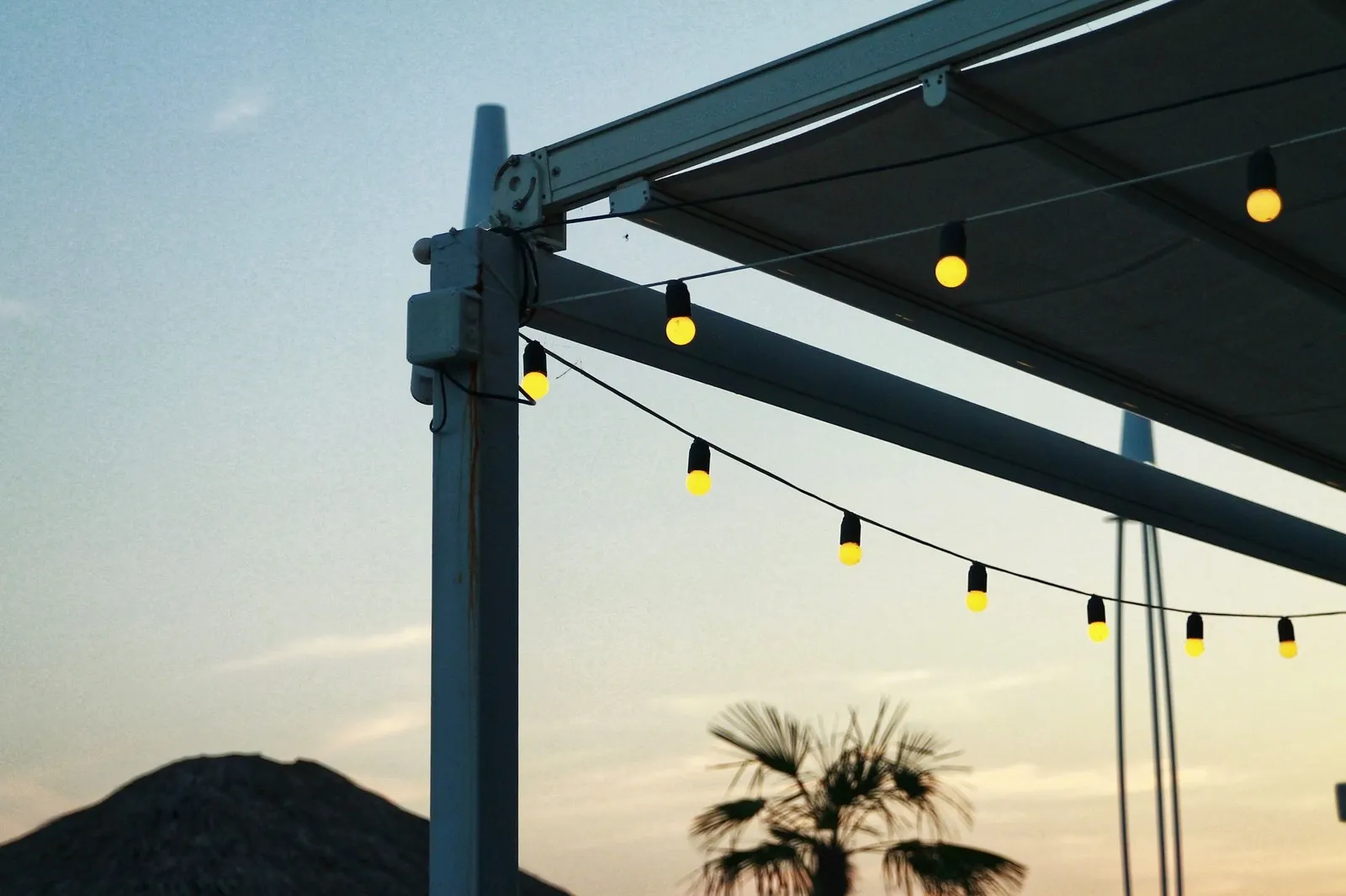
Most bistro layouts are one of three shapes, or a combination. A perimeter run traces the edge of the space — fence line, pergola frame, eave — and suits patios that already have strong boundaries. A canopy criss-crosses strands overhead in a V, X or zig-zag, and is what turns an open patio into something that reads as a ceiling. A single swag line — one deliberate arc between two anchors — suits small spaces, balconies and side yards where one confident line does more than three tentative ones.
Anchors and spans: where sag comes from
Every span needs two things: anchors that can take real load, and enough tension that the strand holds its arc through wind and weather. Pergolas, house fascia with proper hardware, mature trees and dedicated poles all work. The classic failure is anchoring a long span to something light-duty — a gutter, a trellis, a cup hook — and watching the arc deepen week by week. Longer spans on larger patios are guided by a tensioned support cable, with the strand clipped to the cable so the wire, never the light strand, carries the load. That one detail is most of the difference between a professional span and a drooping one.
Power, switching and running cost
Plan the layout back from an outdoor-rated outlet, and let the cord route follow structure — a post, a fence rail, an eave — never a walkway. If the layout ends far from power, that is a sign to reconsider the anchor plan before adding extension cords to lawn. For running cost, the arithmetic is simple enough to do before anything is installed: our energy cost calculator takes a bulb count and your own utility rate and shows the monthly usage.
Where a professional install changes the result
Our bistro and string lighting service handles this whole sequence — layout, anchoring, tensioned spans, power routing — with the same crew and the same standard as our Christmas lighting work: warm white C9 bulbs at 15-inch spacing, elegant and restrained. Every space is different, so it starts with a conversation about yours. The planning above is exactly what that conversation covers, with a ladder we bring ourselves.
Frequently asked questions
Does string lighting have to attach to the house?
No. Pergolas, mature trees, fence lines and dedicated poles all work as anchor points. What matters is that each anchor can hold a tensioned span through wind and weather — a cup hook in fascia board is where sagging strands usually start.
What is the difference between bistro lighting and Christmas lighting?
Bistro lighting is built for the space you use — a patio, a pergola, a seating area — and stays useful all year. Christmas lighting is built for the house itself, follows the architecture, and comes down after the season. We install both, to the same standard.
Can string lighting stay up year-round?
Outdoor-rated bistro lighting is designed for it, provided the spans are tensioned properly and the connections stay off the ground. That is a big part of why the layout and anchoring deserve real planning up front.
Have a patio in mind?
Tell us about your space and we will put together a layout and a quote for it.
Texting works too: 949-806-2333